
9 Best Local SEO Strategies in 2025
Top 9 Local SEO Strategies in 2025: In-Depth Guide
As AI-generated content takes over the internet and the ways people search continue to evolve, how can businesses keep up and—more importantly—stand out in local search results?
We’ve got your back. Below, we discuss the 9 best strategies local businesses can use to rank well on search engines.
Key takeaways: How to do SEO in 2025
- First, use typical strategies like optimizing your Google Business Profile, targeting localized keyphrases, building local backlinks, and optimizing your site’s performance across devices.
- Also, keep your content fresh (consider using a dynamic job map, for instance) and encourage user-generated content.
- In addition, prepare for more voice, image, and AI-assisted searches.
- Finally, hire a skilled local SEO company to get the most out of your resources.
1. Maintain a top-notch Google Business Profile
Your Google Business Profile (also called your “GBP” or, formerly, Google My Business) remains as important as ever in [year], as Google continues to be the most-used search engine. You must do the following to ensure potential customers can find you on Google Maps searches.
Create a Google Business Profile (if you haven’t already)
This involves entering accurate business information, including your business name, address, phone number, and hours of operation. You must also select the business category that best fits your services (be sure to pick the right one to help Google understand your business—this helps with your rankings!)
You can also highlight special features about your business here—like “free wi-fi” or “outdoor seating.”
Worried that potential customers might be using other search engines?
It won’t hurt to create/claim business listings on other search engines, too. This will ensure that the information on those listings is accurate. Still, we recommend focusing first and foremost on Google—Google is king. 👑
Verify your profile (if you haven’t already)
You can verify your profile by using the options available to your profile. The methods you can choose from will depend on your business category, hours, and more (and you may need to use more than one verification method). Learn more through Google support.
Optimize your Google Business Profile
Add high-quality images of your business, products, or services. Regularly update your profile with any changes, plus add new posts about promotions, events, or seasonal information. Actively manage and respond to customer reviews to engage with your audience and improve your profile’s visibility. Finally, use features like Q&As to answer common customer questions and GBP posts to share updates directly on your profile.
Are you a multi-location business?
Multi-location businesses should create separate profiles for each location. Google offers tools for managing multiple locations through a single Google My Business account.
2. Rank for localized keywords
Ranking for localized, high-intent keywords remains vitally important to local businesses. These include keyphrases with location-specific names (for example, “Best movers in Denver, Colorado”), plus proximity-based keyphrases like “near me” (for instance, “Donut shops close by”). The reason they have “high intent” is because the people searching for them usually highly intend to take a specific action—like purchasing moving services or visiting a donut shop.
Ranking for keywords involves knowing what potential customers are searching for. While some people search for broad terms like “nearby plumbing businesses,” others have more specific queries, like “nearby toilet installation services.”
Wondering if you should target keywords like “within 5 miles”?
You don’t need to target every keyword a searcher might use, including “within 5 miles”—Google’s algorithm automatically calculates proximity based on the user’s location at the time of their search. So if someone searches for your business type, wants to see businesses within 5 miles, and your business is within 5 miles, Google will include your business in the results. Where you’ll be included will depend on how well your SEO strategies are working!
Target your chosen keyphrases across the content on your website, Google Business Profile, and social media. These contents will include:
How do you “target” these keywords? It’s as easy as using these keywords and keyphrases (or variations of them—Google recognizes close phrasing) in your digital content in a natural and relevant manner. Make sure they appear in headings, subheadings, the body of your text, meta descriptions, and even in image alt texts (the text that describes images to search engines and users with disabilities).
When targeting keywords, prioritize your website and use your social media sites and business listings to drive traffic to your website. Why? Well, your website is the central hub where you can fully control the user experience and conversion process and measure detailed analytics to refine your SEO strategies. If you don’t have a website, that’s another story—in that case, focus on keyword-optimizing your social media sites.
So, do you want 14 of your webpages targeting the same keyphrase? No. Since targeting the same keyphrase across too many pages can lead to “keyword cannibalization”—where your own pages compete with each other for search rankings—you should typically target specific phrases with specific webpages. (This is also why you shouldn’t, for example, post the exact same blog post on your social media as you do on your website blog—instead, share your blog through your social media.)
Did you like the tips above? We’ll soon be offering an in-depth guide on using keywords and creating keyword-optimized content with tons more tips just like it.
One excellent way to target high-intent, localized keyphrases is to create separate landing pages for separate services on your website. For instance, a plumbing business might create separate landing pages that target keyphrases like, “nearby toilet installation services,” “emergency plumbing repairs near me,” and “affordable bathroom remodeling in Chicago.”
3. Keep your content fresh
You shouldn’t keep just your GPH current—you should also make sure your website, social media sites, and other local listings stay fresh. This means continually updating your content and creating new content.
Search engines prioritize up-to-date, relevant content—but that’s not the only benefit of keeping your stuff fresh. Recent content also tends to:
3 strategies for creating fresh content
Beyond simply updating your sites with current details about your hours, offerings, and more, consider using strategies like these:
| Strategy | Examples |
|---|---|
| 1. Create content about jobs or services you’ve performed. | A hair salon creates new Instagram posts with pictures of recent haircuts and styles—and shares those posts on landing pages advertising specific services. A home construction firm displays a live job map on their website that showcases all the homes they’ve recently completed and where they’ve completed them. |
| 2. Create blog posts that provide valuable content for people looking for localized guidance and other information. Share links to these posts on social media. | A pest removal company creates a blog post targeting the keyphrase „Best way to get rid of ants in Phoenix” that provides genuinely valuable advice for getting rid of ants (while subtly promoting the company’s services). A dermatologist creates a blog post targeting „laser hair removal treatment pricing Phoenix Arizona”—it provides accurate, specific pricing details for these treatments across Phoenix, including the office’s own pricing information. |
| 3. Create new social posts about events, promotions, and other happenings—before, during, and after. | A coffee shop advertises its monthly promotion for a “free coffee with purchase of a bag of ground coffee” across its social media sites. An outdoor gear shop creates a social post about its involvement in an auction that raised money for the local adaptive sports organization. |
How do you make high-quality content?
Start by following Google’s E-E-A-T guidelines. Make sure your content is “people-first” rather than “search-engine-first” (made for helping people rather than ranking for search engines). It should display experience, expertise, authoritativeness, and trustworthiness.
4. Build local backlinks
Building backlinks is still important for local businesses in 2025.
Backlinks are links from one website to another. They help with SEO by increasing a site’s authority and credibility. This improves your domain authority and ratings, which helps your rankings.
You should include internal links across your content—these links connect one page of your own website to another. But, you should also focus on external links: links to your site that come from different domains.
Some of the best external backlinks for local businesses come from other local businesses, media, and influencers. To encourage backlinks from such sources, you might:
5. Optimize your website performance
Optimal website performance doesn’t just enhance your customers’ experience—it also significantly impacts your search engine rankings. Google and other search engines prioritize sites that provide a smooth, efficient user experience—your site should be lightning fast and free from frustrating interface problems.
To ensure top-notch performance, you should enhance your site speed, make sure connections with HTTPS are secure, and fix broken links, among other things. Tools like Google PageSpeed Insights can help you diagnose performance issues—plus they’ll provide recommendations.
Recommendations might include:
Improving your website’s architecture is also a good idea, as this makes it easier for search engines to crawl and index. You should:
If you’re not a technical SEO expert, this might all sound like gibberish—so consider tip #9 below.
Don’t forget about mobile-first indexing
Did you know that Google uses the mobile version of your site to index and rank your content? This is known as “mobile-first indexing.”
Google claims that having a mobile version of your site isn’t a requirement for being included in Google searches—but it strongly recommends this nonetheless.
The gist? Make sure your site is mobile optimized for various devices. Google recommends using “responsive web design” (which is a design approach that automatically adjusts the web page layout to fit the screen size and orientation of any device).
Do you have to use responsive design?
While Google recommends that businesses use responsive web design, there are 2 other Google-supported options you can use. Learn about these and more in Google’s mobile-first indexing best practices.
There are other tactics you can use, too—some which are best handled by technical SEO professionals. These include:
Do you have to use responsive design?
While Google recommends that businesses use responsive web design, there are 2 other Google-supported options you can use. Learn about these and more in Google’s mobile-first indexing best practices.
6. Use a live job map (i.e. Spotlight)
One of our favorite new strategies of 2025 for job-based businesses? A dynamic job map you can display on your website.

This map is linked to your GBP. Each time your business completes a job, the map on your website automatically updates—plus, a new guest post is generated on your GBP.
The result? Fresh, localized, relevant content—with no effort on your part. This is a great tactic for optimizing the searchability of both your website and GBP.
Plus, the geotags signal to Google that your business is operating in certain locations, potentially boosting your ability to rank in those locations.
Did you know?
SurMarketing just rolled out this feature, and our first clients have seen amazing results.
With any of our Boost packages, you can try it out too—no add-on costs required.
7. Encourage user-generated content
User-generated content (UGC) is becoming more and more important. UGC includes:
UGC can help with SEO in many direct and indirect ways—from boosting your GBP and providing organic backlinks to simply encouraging users to visit and spend time on your site (again, search engines like Google note this user behavior and factor it into their rankings). You can also curate positive UGC to display it on your website.
How to encourage your customers to create favorable content
Here are our top tips for encouraging your customers to create content:
Provide great service
This tip should be obvious, but it’s worth emphasizing: Great service breeds great reviews, recommendations, and referrals—and these happen organically.
Worried about bad reviews? We get it…service slip-ups happen!
Actively manage and address customer reviews in a positive way to bolster your company’s reputation. Also, consider asking customers for private feedback on your services to give them the opportunity to air and address any grievances with you before they post them on review sites. If customers give great private feedback, ask them, “Would you mind posting this on [our Google Business Profile]?”
Nudge your customers to provide reviews, testimonials, and referrals
One of the best ways to nudge customers to create content is to make it easy for them to do so.
For instance, when asking for testimonials, provide clear, easy-to-follow guidance, like, “In 2-4 sentences, could you describe your problem and how our product helped you solve it?”
Incentives are also great (as long as they’re ethical). For instance, referral discounts are a great way to get referrals from satisfied customers: “I’m glad you’re happy with our services! Refer your neighbors on Nextdoor to our landscaping company, and we’ll give you 20% off your next lawn maintenance!”
There are various ways to encourage users to share content you’ve created.
For instance, embed social share buttons prominently on your content pages, such as blog posts and product/service pages. You might also want to create content with high “shareability”—for instance, a plumbing company might share an amusing meme poking fun at DIY plumbing repairs gone wrong.
8. Get ready for more AI, voice, and image-assisted searches
2025 is seeing tons of new tech trends making waves across the globe. Three trends we think will have the biggest impact on SEO are AI-assisted searches, voice searches, and image searches (that last one might also feature augmented reality).
Let’s dive more into these.
AI-assisted searches
Search engines like Google are increasingly using AI to deliver zero-click search results to users (these directly answer user queries so they aren’t required to “click” on any results).
Let’s take Google’s Search Labs as an example.
This mysterious tool appears to have many in-testing and in-development experimental features, but one such feature is the AI Overview, which appears at the top of certain search results. Take a look:
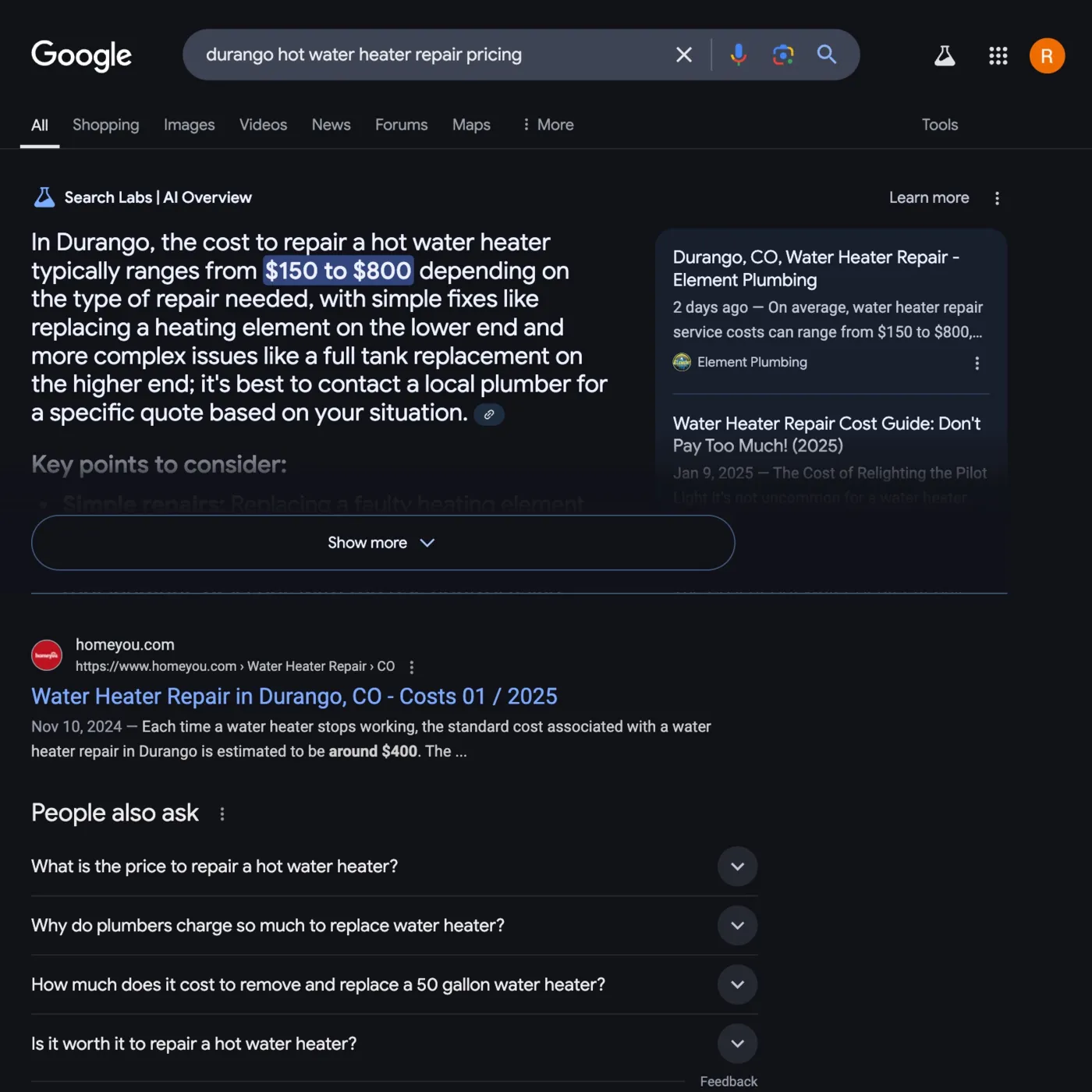
As you can see, Google’s AI pulls information from other top-ranking sources to create its answer to the search query, “durango water heater repair pricing.
”What does this mean for local businesses? Well, the answer—right now—is that they should start (or keep) making high-quality content that Google’s AI might pull answers from. Google’s AI includes the sites it uses next to its answer, so users might be encouraged to click on those sites. Some of these sites are local businesses, so users might even decide to use their services (users might assume that those businesses have higher authority simply because Google is spotlighting them).
Please note that several local searches don’t have an AI overview answer. For instance, search results for “best plumbers durango” doesn’t. Instead, the map listings are at the top:
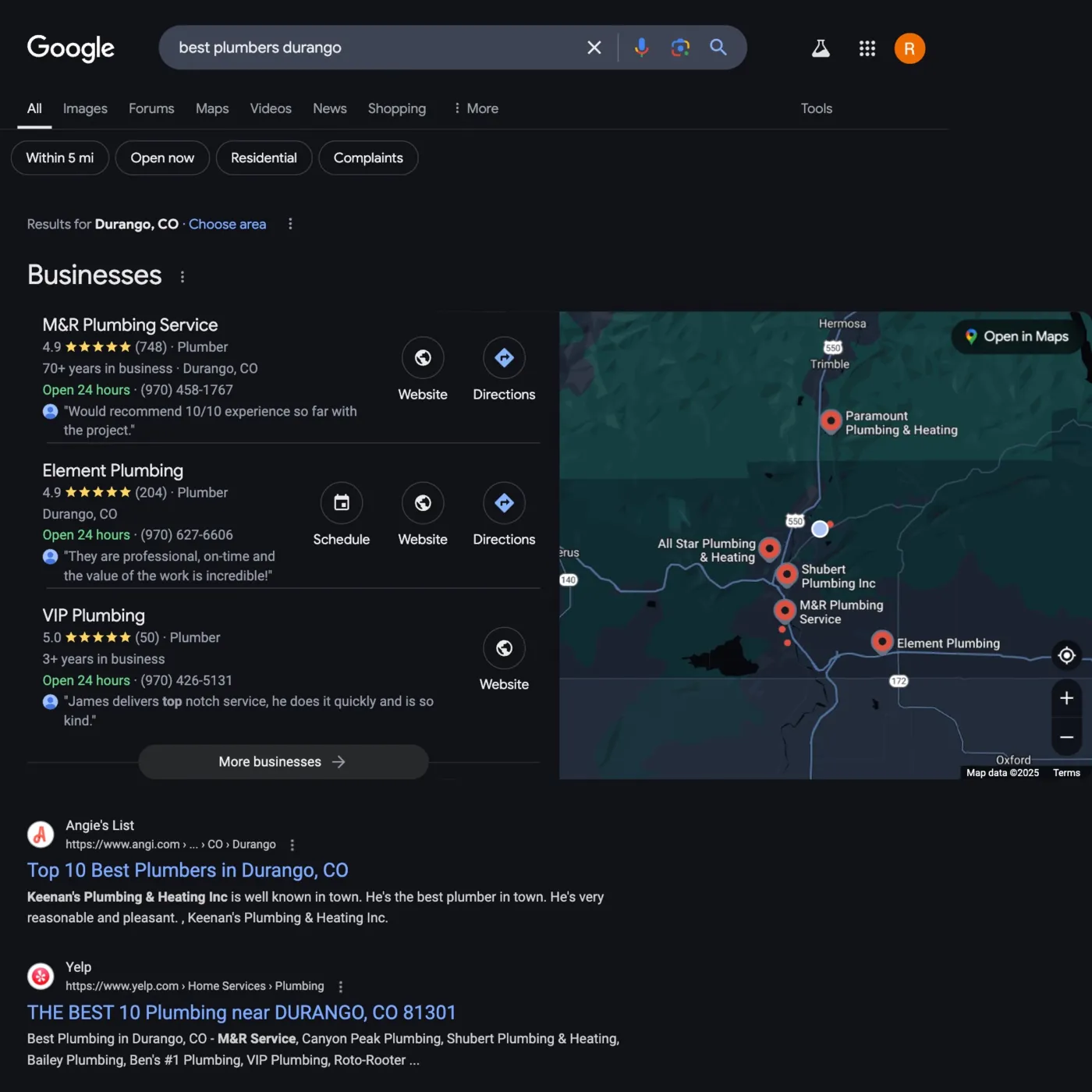
The AI overview seems to appear most often for informational searches—the users’ intent here is to find information and not necessarily to make a purchase (though they might be close to deciding to make a purchase).
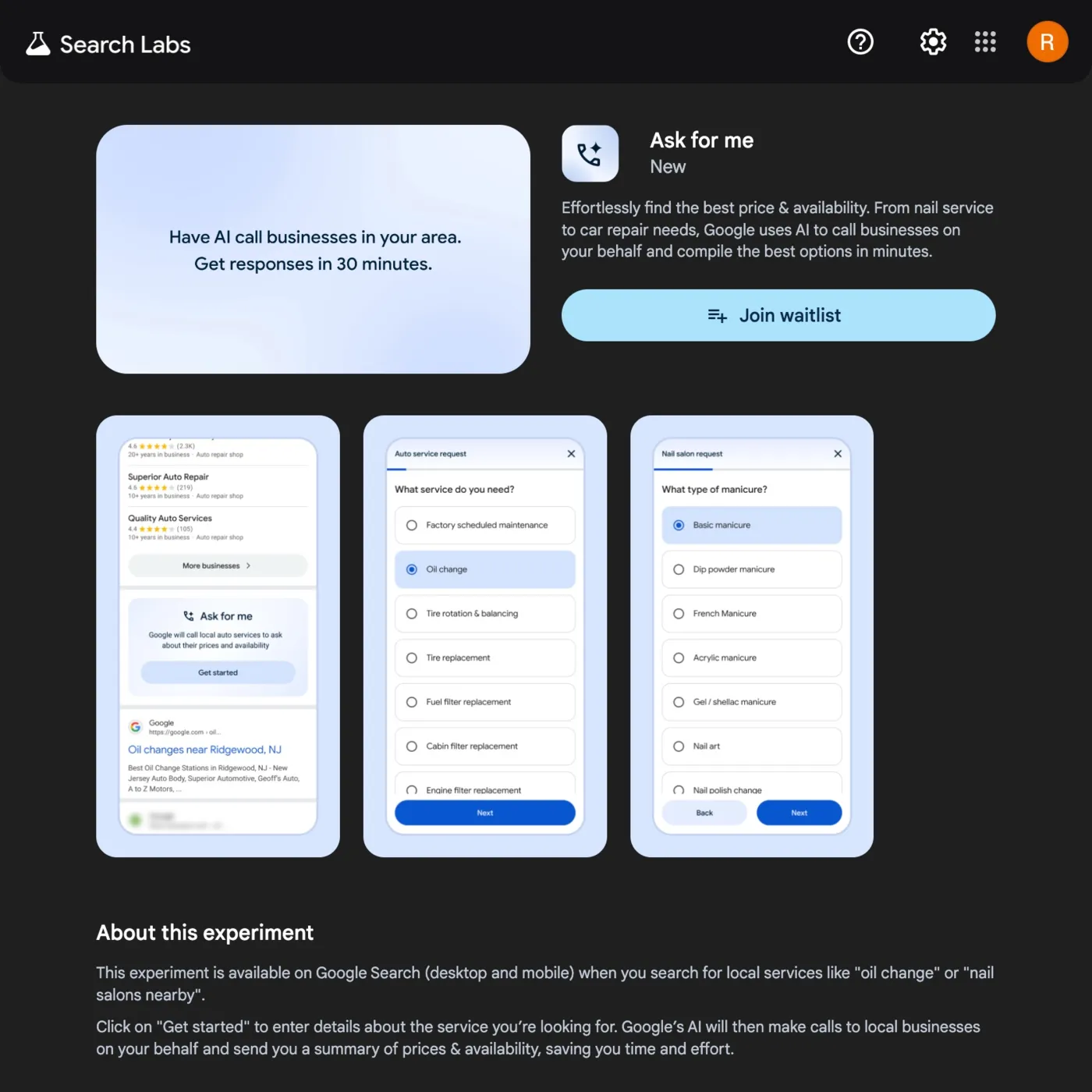
There are several other AI services in development intended to help users find the info they need more efficiently. For example, Google is currently experimenting with an “Ask for me” service, where its AI calls businesses for customers to learn about availability, pricing, and more:
Some users are also using generative AI tools to conduct internet searches. The good news? These tools use search engines and prioritize top-ranking sites. That said, some tools use search engines other than Google—for instance, ChatGPT uses Bing. (Concerned? Consider keeping your Bing Places for Business listing current.)
The best thing to do at this point is to be aware of AI search trends—and consider how they might be impacting user searches.
Voice searches and voice search optimization
With the rise of voice assistants like Alexa and Siri, people are increasingly using voice search to look for local businesses. In fact, according to Demand Sage, about one-fifth of people across the globe use voice search. And local searches—including searches using phrases like “near me”—make up over three-quarters of voice searches. The number of people using voice search to find local businesses is expected to keep growing.
So, you must consider voice search optimization when targeting keywords to rank for.
Voice searches tend to be more conversational and lengthier than typed-up searches since speaking is easier than typing.
Voice searches for local businesses also tend to use a combination of several phrases, including proximity-based phrases like “within walking distance” and descriptive phrases like “low-cost” or “open late.” Searchers might also look for specific services. Here’s an example:
“Siri, can you help me find a low-cost nail salon that’s near me, open late, and offers gel nail art?”
Targeting keyphrases—especially long-tail keywords—containing these various elements is a good idea.
Image-assisted searches (plus augmented reality)
Users are also using applications like Google Lens to search for information using images.
For example, someone might take a picture of a restaurant to learn more about it (like its rating, reviews, and hours of operation).
Some tools offer augmented reality (AR) tools to “augment” real-life locations with graphics. For example, a user might point their phone camera at a restaurant and see, through their phone screen, ratings and reviews overlaid on top of that restaurant’s image.
Some AR tools—like Yelp’s Monocle—have come and gone, but we believe that AR is primed to make a comeback.
What does this mean for local businesses? Again: effectively using the strategies we outline above should do you the most good in this realm. For instance, if you keep your GBP up to date and optimized, then any potential customer using Google Lens to perform image-assisted searches should be able to quickly find accurate, (hopefully) compelling content about your business.
9. Hire a local SEO company
Doing all the above strategies on your own can feel impossible—especially if you don’t have the knowledge, skills, or manpower. That’s why hiring a competent SEO firm might be one of the best local SEO strategies you can use.
Competent local SEO companies can provide the expertise and resources needed to effectively implement these strategies. Plus, they stay updated on the latest SEO trends and algorithm changes so you don’t need to. The result? You can focus on running your business while the pros boost your online presence.
Let SurMarketing help you use the best local SEO strategies today
In 2025, the best local SEO strategies include back-to-basics strategies like optimizing your Google Business Profile, targeting localized keywords, and generating backlinks. Fresher strategies include using a live job map and prepping for more voice, image, AI, and AR-assisted searchers.
Finally, hiring a local SEO company is one of the best actions you can take to ensure you perform these strategies effectively. SurMarketing is one of the best local SEO companies—we can help you take your local SEO tactics to the next level, boost your online presence, and help you attract (and land) more customers.